Pack control
Guides, belts and hold-downs should be chosen around the product shape.
Tapered bottle labelling
Tapered bottles can make label placement more difficult because the label face is not parallel from top to bottom. Machine trials help confirm label shape, wipe-down and visual alignment.
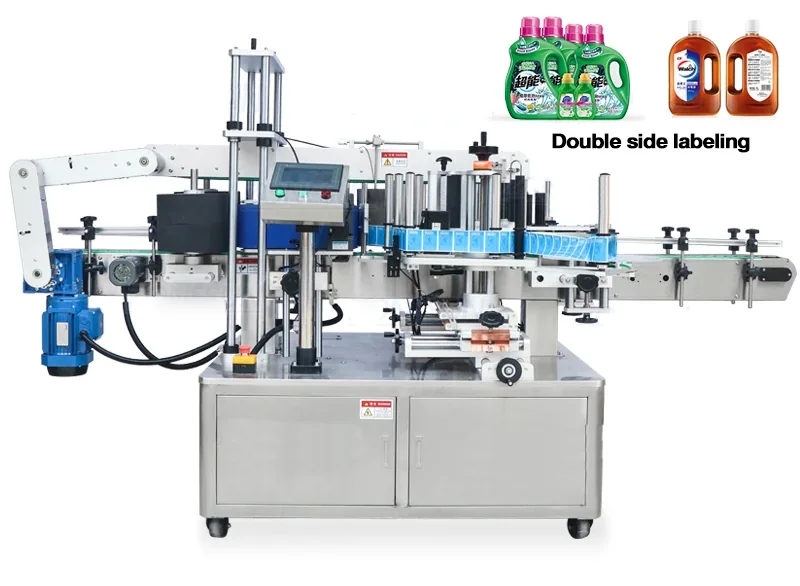
Selection intent
The application route should start with the real product, not a generic machine name. Shape, height, width, weight, surface finish and stability all influence how the pack travels through the labelling station.
The label material also matters. Paper, film, clear labels and textured stocks can require different sensing and wipe-down methods.
Guides, belts and hold-downs should be chosen around the product shape.
Paper, film and clear labels may need different setup and sensors.
The machine should match the realistic production rate and changeover pattern.
Machine routes
Most projects start with the pack shape, label position, material and output. These are the core machine routes to compare before requesting a quotation.
Best for established production where two labels need to be applied consistently in one pass.
Useful for smaller footprints, lower-volume production, trials and fast SKU changes.
Useful for flat packs, cartons, trays, sleeves and products requiring label application to upper and lower faces.
Quote preparation
For this application, include product dimensions, photos, label artwork, label stock and details of the current or planned line speed.
Where several pack sizes are involved, send the extremes of the range plus any awkward packs. The most difficult pack often determines the correct handling setup.
Related pages
These pages help connect the search route with machine type, application and buying guide intent.
Automatic front/back route for production.
Compact route for smaller sites.
Control label position and tolerance.
Details to send with a quote request.
The useful starting details are container dimensions, label size, label material, output target, photos of the pack and whether the labelling machine needs to connect with filling, capping, coding or inspection equipment.
Yes. Lancing UK can compare compact, automatic, twin-side and top/bottom labelling options against the pack, label material, changeover needs and output target.
Yes. Samples, drawings, label artwork and short videos of the current process help confirm handling risks before a final machine recommendation is made.
Share the pack, label material, output target and any integration requirement. The team can help you compare the most suitable compact, automatic or top/bottom labelling route.
Taper and presentation
A tapered bottle changes width along its height, so a label that sits correctly at one edge can lift or wrinkle at another. A tilted bottle creates a different fault: the application datum moves as it passes the head. Record container orientation and label-panel geometry separately before changing pressure or trying to correct the artwork.
A rectangular label has equal top and bottom edge lengths, while the available path across a tapered surface may differ between those edges. Forcing the excess material flat can create folds or lifting. The converter may need to alter label shape, size or construction, while the machinery review checks orientation and contact. A machine adjustment cannot always compensate for an unsuitable label die-cut.
Supply representative containers and the converter’s label drawing, identify the front and rear datums, and include photographs of failed and acceptable samples. State the normal filled or empty condition. Loose artwork alone does not establish how the liner releases or how a shaped label travels through a sensor.
Use the container-panel guide for geometry and the wrinkle and bubble guide for fault separation.
Include the container, both label constructions, target output and any existing line constraints.